
Power, Part 2
What power is and how it is accumulated.

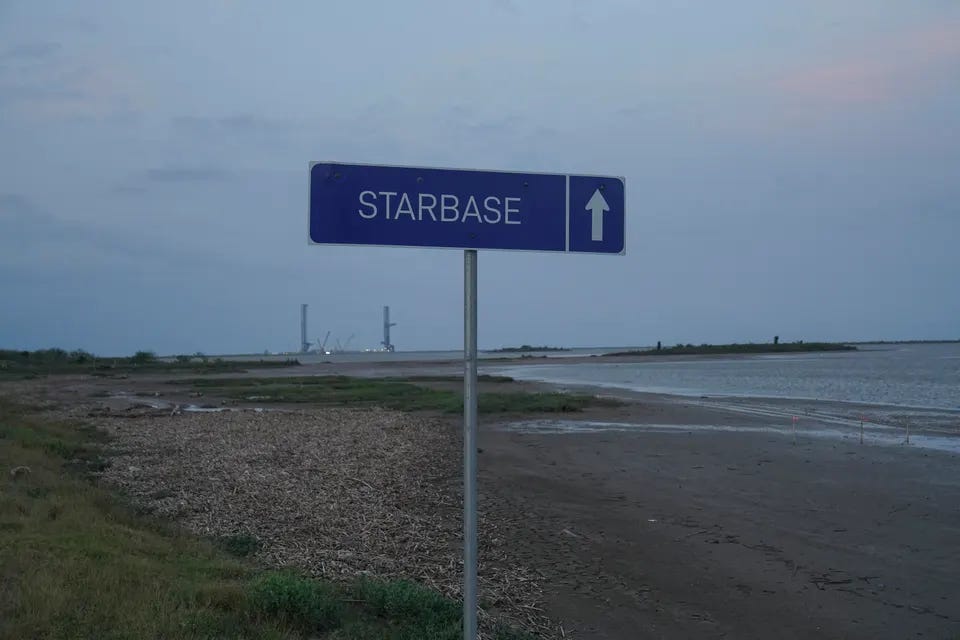
“The incorporation of [Starbase] seems to be primarily a question of control for SpaceX. The new city would directly manage its building and permitting, eliminating regulatory hurdles it might have to jump through at the county level. It would control its own land use laws and local taxes, and would also allow it to apply for state and federal grants. Although the ability to shut down the highway for launches is helpful, a Starbase city would have autonomy that extends far beyond that.” [1]
“…staff could begin applying last year for homes with rents as low as $800 for two and three bedrooms, and if a staffer is fired or leaves, they would have to move within 30 days, the paper reported.” [2]
What is Power?
Power is the ability to bend the world to one’s will.
Power is the degree of separation between a person giving orders and a person following them.
Power is secured using wealth and using force. It is created by labor applied to land, machines, raw materials, or combination thereof.
In all things, power is applied knowledge.
Power Accumulation as a Function of Wealth:
Wealth, to the degree that it secures power, is the use of money to secure factors of production — the inputs and processes needed — for the output of one’s realized goals. It is the payment of wages to others in exchange for their servitude.
The deployment of capital secures the materials, land, labor, etc. — the factors of production — and is what sets up the process to transform inputs into outputs. This process is subsequently put in motion and sustained via applied labor.
The difference between the worker’s production and the cost of production is then funneled back into capitalist pockets (as the owners of the means of production), and into the state’s coffers (as the controller of the territory where production or exchange takes place).
This funneled wealth is then reused to begin the cycle anew — albeit either more expanded, differentiated, or protected than in its previous cycle.
This process is how power is accumulated as a function of wealth.
The reason why money is required to secure power is because we live in a world where access to essential goods and services is paywalled. Access to the means of producing said goods and services is also paywalled. The final nail in the coffin is in the mandatory payment of taxes to the state, which must be paid in its chosen currency (or else prison).
There is not anywhere a condition of total economic independence and self-reliance. Everyone must pay taxes, buy food, pay for housing, pay for transportation, etc. We live in a currency-based market economy. Exchange-value (price point & liquidity) has overwhelmingly out-compete use-value (objective usability) in the economic organization of modern society.
This is why the advertisements on TV for cars aren’t going on about what they’re made of so much as how they’ll make you feel. Things like NFTs and cryptocurrency, as well as the broader financialization of the economy, all revolve around economic organization of modern society prioritizing exchange-value over use-value.
What this Means for Today’s Organizers:
The rise of the market economy has made it largely impossible to exist in our society without an income. Business owners and government officials must pay their workers in wages. In return, the worker is made subservient. Absent those wages, absent any cash-generating assets that return enough money to live on, one can only be a beggar, a dependent, or a deceased person. [Note 1]
It is because of this economic reality that volunteer organizations are not viable power structures. The unpaid volunteer organization can be viable as a temporary stage of a power structure or a permanent layer of a power structure — even large corporations have unpaid interns — but ultimately this cannot be a permanent overall condition for either a person or an organization seeking power. At some point, it must produce goods or services that become monetized for the unavoidable reason that life costs money. The financial pressures we all face as a class of people who must sell our labor to survive — these pressures eventually win out. It is necessity — rather than greed (although not exclusive to greed) — that is the root cause of why contemporary organizations overwhelmingly build power through the creation and control of wealth. [Note 2]
Relying on uncompensated labor given by people who must sell their labor for survival is inherently a non-viable power model in a market economy.
Relying on applied labor absent the ability to control other factors of production (i.e. land, capital, etc.) does not successfully produce the output of one’s realized goals.
Successfully producing and distributing wealth is what creates a positive feedback loop for applied labor that has long-term viability. Taking some of this wealth and anchoring our organizations and our people in the collective ownership of the factors of production we need to create the future we want is what will create forward progress.
Collective ownership is how to tap into power accumulation as a function of wealth.
The objective of a revolution is to take control over the means of production. The point of controlling the means of production, at least for those interested in liberation, is to create a world where individuals and communities are empowered.
By pooling our resources in a way that is both democratic and financially literate, we can work on building counter-institutions that intentionally empower labor over capital.
This is how, in the here and now, we will begin to overturn the status quo.
Economic Viability, Making it Personal
I have never had a chance to take independence for granted. I was raised in an environment that was very strict and very “my house my rules”. Personal boundaries weren’t particularly respected, and familial infighting was constant. Autonomy is something that had to be taken, not given.
I was so happy when I moved out of the house for college. I finally got a little freedom.
In order to have autonomy in the United States, a person must have money. The less money a person has, the more they are forced into paternalized conditions as a dependent of others or as a dependent of the state. It is in these suffocating conditions that a small percentage of people actually will choose to sleep outside.
Freedom or death, right?
If I knew one thing I wanted in life at 18, it was to never depend on anyone else for money. I had lived my whole life longing to be free. Going to college and getting a degree that I could immediately get employed with was my exit plan. That and moving somewhere new — a clean start, no backstory, no strings.
I didn’t know much about the world at 18. One thing I did know was that most of the people graduating from college and landing a job were getting business or engineering degrees. I was good at math, but the As I got were typically *just barely* and I couldn’t do proofs to save my life. Engineering looked intimidating as hell, so I picked business.
No money, no freedom.
As a consequence, subjects that round out a person’s understanding of the world weren’t things I took seriously at the time. Sociology, Psychology, Communications, English, etc. My favorite subject in high school had always been History, but in high school it was also free.
I went on to graduate pretty high in my class. Got a competitive job with competitive pay.
Eventually, and I’m not sure how to describe it even after all these years, my body rejected the mask I had been clinging on to.
It wasn’t pretty.
The point of all this is that economic viability impacts academic and professional choices. It also impacts activism and organizing. The lack of economic viability in most of today’s change efforts is — in 2025 — the main blocker to changing the status quo.
Who can risk revolutionary thought — let alone action — when it jeopardizes housing and employment? Throw in the pressures of cultural conformity, the most reliable outcome is manufactured consent.
Labor has been subordinated to capital. If we want to gain ground — and that means power — then we need to start subordinating capital to labor.
“It is difficult to get a man to understand something, when his salary depends upon his not understanding it.” — Upton Sinclair
Conclusions, Up Next:
In order build power, I believe we must engage in economically viable organizing.
Viability attracts people from layers of society far deeper and broader than the dreamers and early-adopters. Self-sufficiency in funding requires the active generation and growth of funds. It also prevents the institutional capture threatened by state-based or foundation-based funding.
Generating and growing funds in a way that subordinates capital to labor rather than perpetuating the status quo is what will become the economic backbone of counter-institutions. [Note 3]
Wealth secures the factors of production, among them labor. Applied labor creates power. It transforms factors into means, creating outputs.
The forever rule of: “all revolutions require money” remains true.
Yet, power accumulation is not only a function of wealth. It is also a function of force. Neither a revolution, counter revolution, nor the day-to-day status quo is sustainable absent force.
The next article in this series will dive into power accumulation as a function of force. As with this one, it’ll have some controversy.
Stay tuned.
Note 1:
Clever readers may point out at this moment that it is not money itself, but rather what money provides access to that is needed to live. This is correct, although at some point it must turn into money (monetization) due to state-required taxes (i.e. the government is the force-backed demander of its chosen currency, even if everyone returned to barter or moved to alternative currencies). This reality represents both the positive viability and negative limit of such economic experiments within the current organization of society.
Note 2:
Monetization is not identical to commodification (although not exclusive to commodification). For example, labor unions are mainly funded through working dues. These dues are paid because of the value produced through collective bargaining. This value does not have true exchange-value (a union member cannot sell their membership), but wages, health insurance plans, and pensions have a monetary value. Another example is large religious institutions. These institutions do not typically produce goods and services for market sale. What they produce are services (pun intended) that people are willing to donate towards to guarantee continuity. These donations are then redistributed to the institution’s paid staff, general fund, etc. and grown through cash-positive expansion and investment.
Note 3:
“In a way that subordinates capital to labor” will be expanded upon in a future article on Revolutionary Objective. There are many kinds of collective ownership and decision-making models in existence. Some of these reinforce the status quo, some change it. All compete with one another for economic dominance and cultural acceptance (i.e. legitimacy).
References:
[1] McCarthy, W. (2025, May 2). ‘He’s Trying to Colonize This Community’: Inside Elon Musk’s Plan to Take Over This Texas Town. Politico. https://www.politico.com/news/magazine/2025/05/02/elon-musk-spacex-texas-starship-00317693
[2] Kilander, G. (2023, March 10). Elon Musk is building his own town in Texas. this is everything we know. The Independent. https://www.independent.co.uk/news/world/americas/elon-musk-texas-town-b2298276.html
Hey You!
If you’ve read this far, engagement goes a long way. Leave a comment and let me know what you think about the article! Likes, shares, and subscribes are also always appreciated.
Have a good one!